We use essential cookies to make our site work. With your consent, we may also use non-essential cookies to improve user experience, personalize content, and analyze website traffic. For these reasons, we may share your site usage data with our social media and analytics partners. By clicking “Accept,” you agree to our website’s cookie use as described in our
Cookie Policy
Privacy Overview
This websteuses cookesto mproweyourexperience whleyou navieatethroughthe webste,
0ut of these cookies, the cookies that are categorized as necesany are stored onyour bronser as they are esentiaforthe working of basic functionalties of the website.
we aso usethird:party okies thathelp us anahze and undersand howyou usethiswebsite,
These cookieswl bestored in your browseronly withyourconsent.
You also have the option to opt-out ofthese cookies.
But opting out of some ofthese cookies may have an efect on your browsing experience.
Your company account is blocked and you cannot place orders. If you have questions, please contact your company administrator.
You have special order items in your shopping cart, please note that item descriptions with “*” denotes a “Special Order Item” which cannot be returned for refund, nor cancelled once ordered.
Why Australian Enterprises Are Moving Generative AI Workloads Off the Public Cloud
20 May 2026
·Blog
·DiGiCOR
The Shift from Experimentation to Enterprise AI
Generative AI is no longer a side project. Across Australia and New Zealand, organisations are moving from isolated pilots to enterprise-wide production deployments — embedding AI into operations, compliance workflows, customer experience, and decision-making systems.
Public cloud LLM APIs played an important role in early experimentation. They made it easy to start.
But at scale, a different reality emerges.
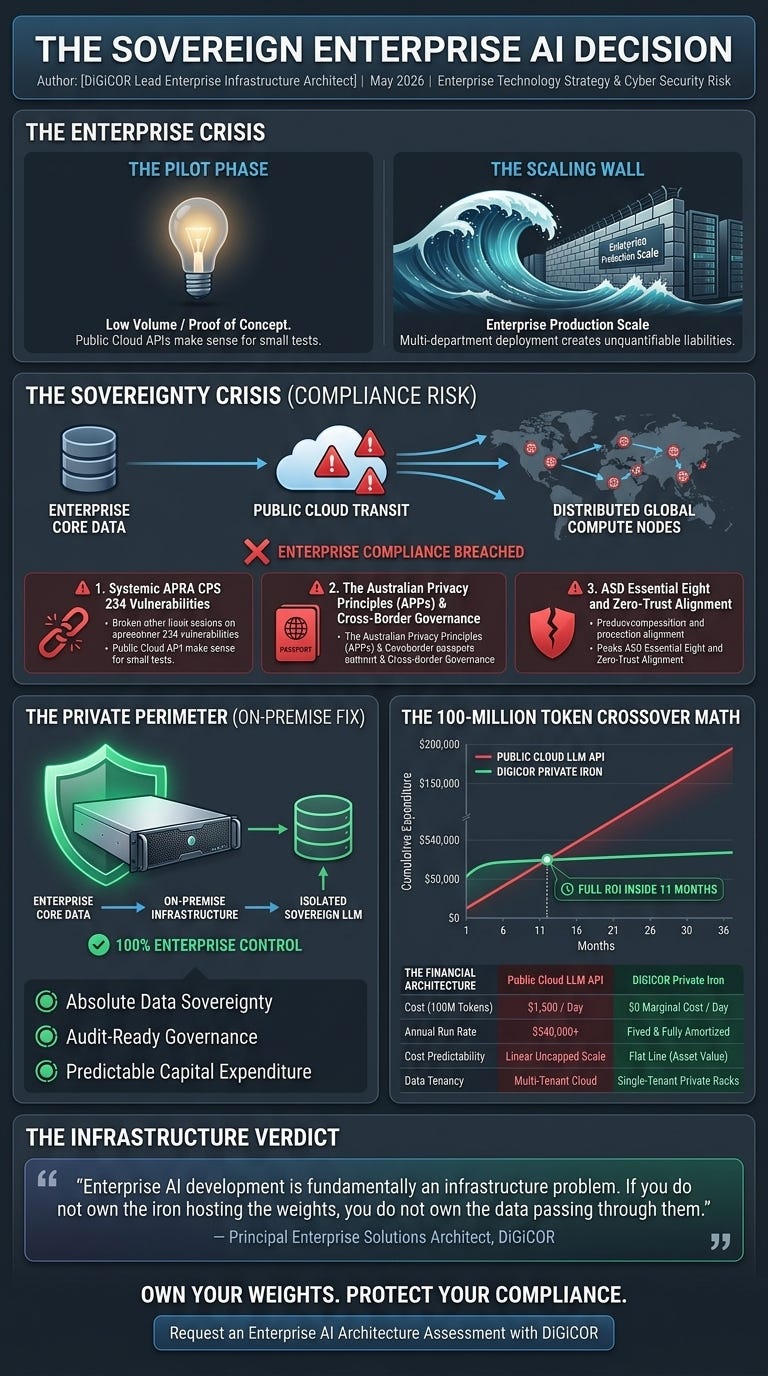
When AI begins interacting with ERP systems, financial data, customer records, and internal IP, organisations quickly confront three fundamental challenges:
Data sovereignty risks
Regulatory exposure
Unpredictable operating costs
For enterprises operating under APRA, the Australian Privacy Act, or ASD frameworks, these are not theoretical concerns — they are board-level risks.
The Sovereignty Problem: Where Does Your Data Actually Go?
Integrating public AI APIs into business systems creates a data pipeline most organisations cannot fully audit:
Even when using major providers, workloads may be dynamically routed across global infrastructure.
This creates immediate compliance tension:
1. APRA CPS 234 — Third-Party Risk Exposure
APRA-regulated organisations must maintain full accountability over all information assets. When AI processing is outsourced to third-party platforms, data handling extends beyond your direct control, increasing audit complexity and vendor risk.
2. Australian Privacy Principles (APP 8)
Under APP 8, organisations remain legally responsible for personal data even after it leaves Australia. Cross-border disclosure via AI APIs introduces ongoing liability if downstream systems mishandle that data.
3. Essential Eight & Zero-Trust Architecture
External API dependencies expand the attack surface and introduce uncontrolled data egress paths, making it significantly harder to achieve mature security posture targets.
The Enterprise Pivot: Owning the AI Infrastructure
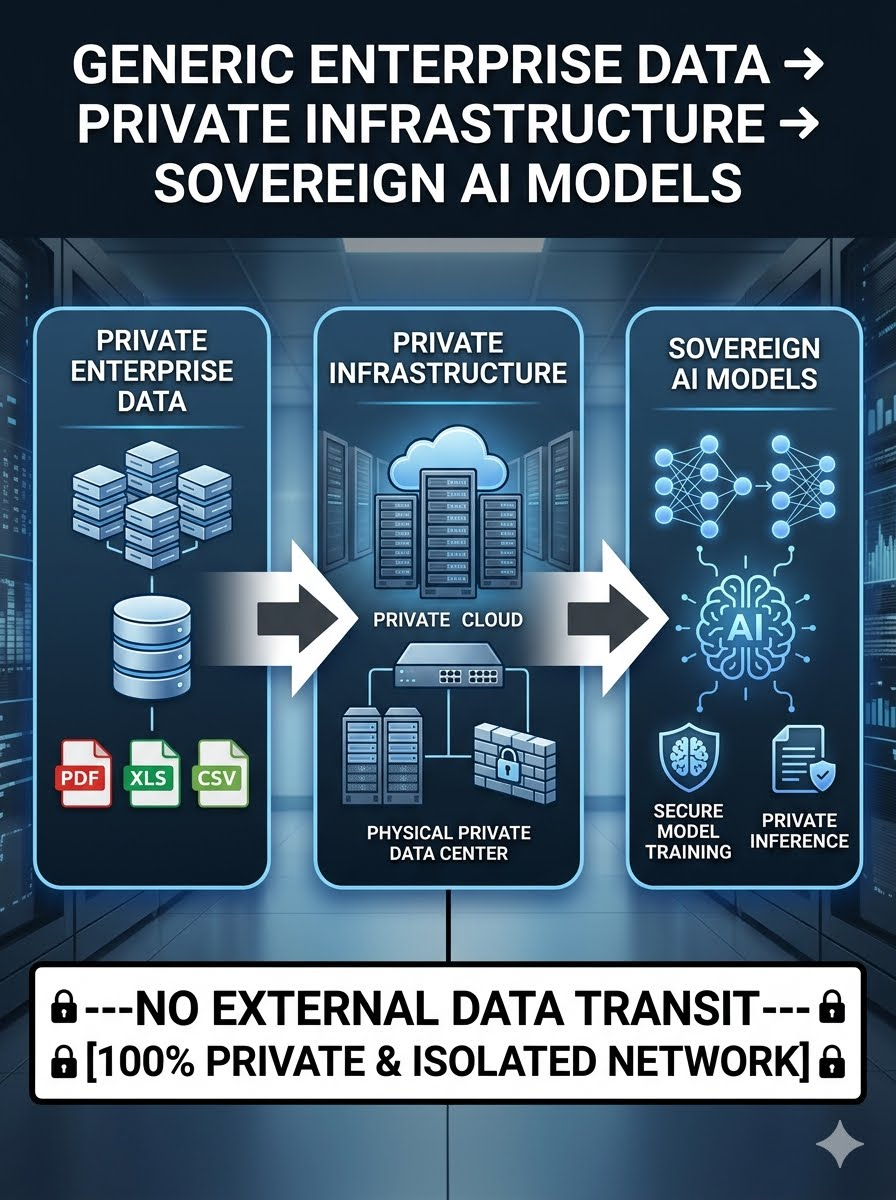
To solve this, organisations are shifting toward on-premise or sovereign AI infrastructure:
[Enterprise Data] → [DiGiCOR Infrastructure] → [Private AI Models]
└──── No External Data Transit ────┘
This approach restores control across the entire AI lifecycle.
Key Advantages
Full Data Sovereignty — Data never leaves your controlled environment
Audit-Ready Security Controls — Align AI systems with existing IAM, RBAC, and network policies
Regulatory Alignment — Designed to support APRA, APP, and Essential Eight frameworks
Predictable Cost Model — Shift from variable OpEx to controlled CapEx
Choosing the Right Infrastructure Tier for Your AI Strategy
One of the biggest misconceptions in the market is that AI infrastructure is “all or nothing.” In reality, successful deployments are highly tiered based on workload scale, maturity, and use case.
DiGiCOR delivers infrastructure across the full spectrum:
These systems are purpose-built for sustained AI workloads, supporting high GPU density, power stability, and thermal design required for continuous operation. [digicor.com.au]
✅ Enterprise-ready performance ✅ Predictable scaling ✅ Strong ROI vs cloud usage
AI environments at this level require end-to-end system design, not just servers — including networking and storage to avoid bottlenecks. [digicor.com.au]
✅ Scalable to enterprise-wide AI adoption ✅ Designed for long-term growth ✅ Full infrastructure sovereignty
The Financial Reality: When Cloud AI Stops Scaling
At low usage, cloud APIs are cost-effective.
At enterprise scale, costs grow linearly:
Scenario
Cost Model
Behaviour
Public Cloud AI
Pay-per-token
Costs increase with every request
DiGiCOR Infrastructure
Fixed hardware investment
Costs stabilise over lifecycle
For example:
At 100M tokens/day, enterprise API usage can exceed hundreds of thousands annually, depending on model tier
A dedicated GPU server operates 24/7 with zero per-token cost, delivering predictable long-term value
The key insight is not that cloud is “bad” — but that cloud is not designed for high-volume, persistent enterprise AI workloads.
Why DiGiCOR Is Built for Sovereign AI Deployment
DiGiCOR is not a hyperscaler. That is precisely the advantage.
We operate as a vendor-agnostic infrastructure partner, designing solutions that match your exact compliance, performance, and budget requirements.
What sets DiGiCOR apart:
Australian-owned and operated since 1997
ISO 9001 & ISO 27001 certified
Approved supplier for government and regulated sectors
Our systems are engineered for AI, HPC, and enterprise workloads, with configurations supporting multi-GPU architectures, high-bandwidth data flows, and scalable deployment models.
Future-Proofing Your AI Strategy
Enterprise AI is not just software.
It is infrastructure, governance, and control.
If you do not control where your models run, you do not control:
Your data
Your compliance posture
Your long-term cost model
Australian enterprises are recognising this shift.
The next phase of AI adoption will not be defined by who uses AI — but by who controls it.
Start with an AI Infrastructure Assessment
Every organisation’s AI journey is different.
The right architecture depends on:
Workload scale
Data sensitivity
Compliance requirements
Growth trajectory
DiGiCOR works with enterprises across ANZ to design AI-ready infrastructure aligned to real-world operational needs.
Request an AI Infrastructure Readiness Assessment to map your current and future AI workloads to the right infrastructure tier.